
Three Firms Raised Nearly Half of All VC Capital — Here's the Opportunity for Everyone Else
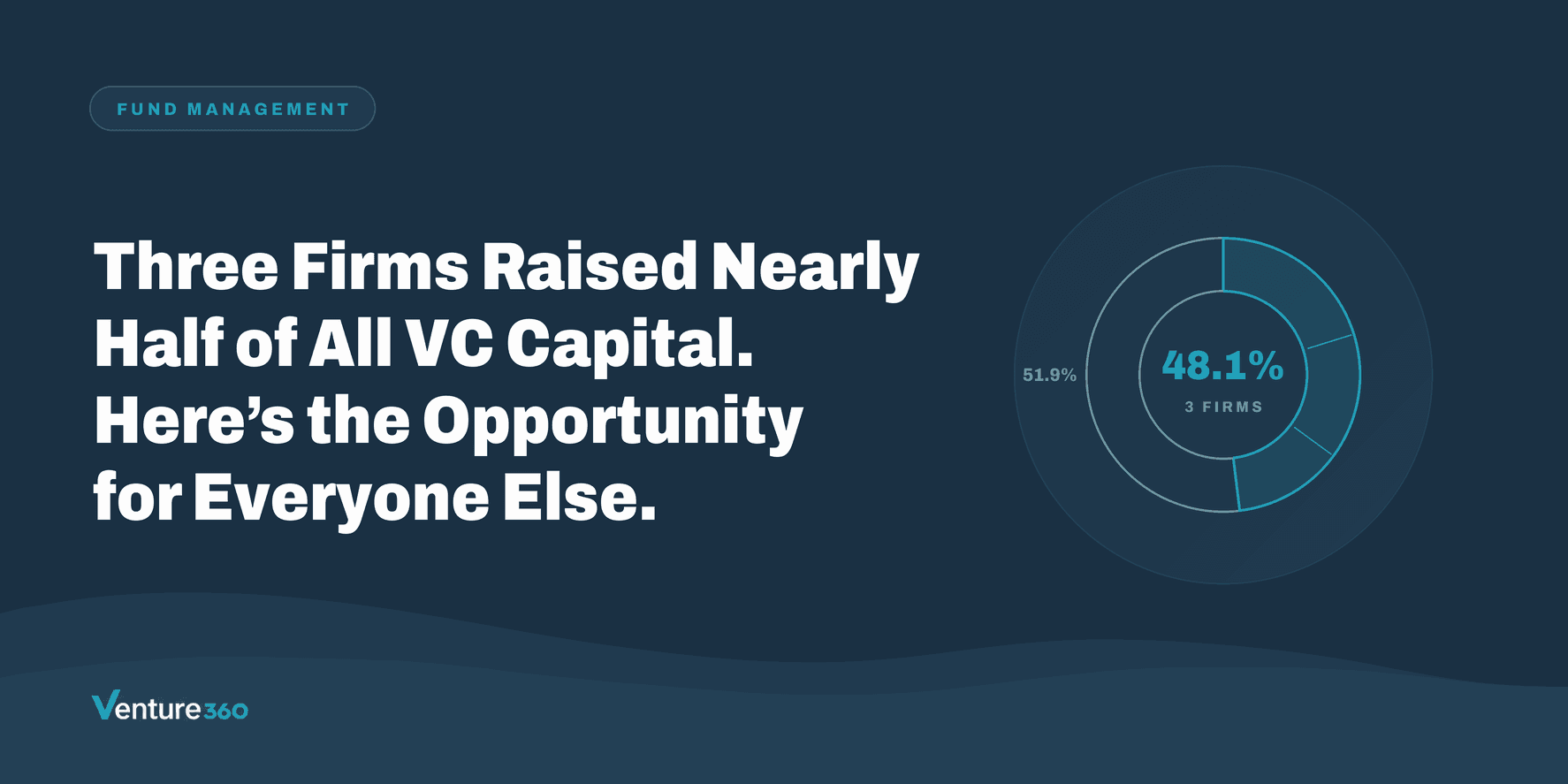
Here is the most lopsided statistic from the first half of 2026: of all the capital raised by venture funds (every fund, every strategy, every geography) 48.1% went to just three firms. Andreessen Horowitz, Thrive Capital, and Founders Fund collectively absorbed nearly half of what LPs allocated to the entire asset class.
Venture capital has always had a power law at the company level. What's new is a power law this extreme at the fund level. Most coverage frames this as a threat to everyone else. We'd argue the opposite: for emerging managers who understand what the concentration actually means, this is the best positioning opportunity the market has offered in years.
The consolidation, by the numbers
First, the honest picture of the seesaw:
- 48.1% of all VC fund capital raised went to a16z, Thrive Capital, and Founders Fund
- Emerging-manager fundraising is down roughly 35% year over year
- First-time fund formation is on pace for its lowest year since 2016
- PitchBook describes a market concentrating at the top while "contracting in almost every other segment underneath it"
Why are LPs doing this? Liquidity anxiety rewards incumbency (nobody gets fired for re-upping with a16z). AI raised the perceived cost of missing out, and LPs believe the biggest firms have privileged access. And scale itself became a product: the mega-firms now sell one-stop, multi-stage exposure the way asset managers do.
But every one of those forces has a flip side, and the flip sides all point the same direction.
Access is the emerging manager's advantage
An underappreciated fact of the concentration story: most investors who want venture exposure are not able to invest in those three funds.
The minimums are institutional-scale. Commitments to top-tier mega-funds typically start in the millions and run to $25M+ for meaningful allocations. That math only works for large endowments, pensions, sovereign funds, and the biggest family offices.
Access is invitation-only. These funds are perpetually oversubscribed by existing LPs. Even institutions with the check size frequently can't get an allocation; a16z's recent vehicles closed on existing relationships before new investors ever saw a deck.
Fees favor the manager, not the LP. At mega-scale, management fees on billions become the business model. The economics that made venture attractive (alignment through carry) are diluted.
This is where emerging managers fit. With minimums typically in the $100K-$500K range, an emerging manager is a practical entry point for a large pool of capital: family offices, successful founders and operators, smaller endowments and foundations, and RIAs building alternatives allocations for clients. These investors want venture exposure but sit below institutional minimums, and mega-fund allocations were never realistically available to them. For this audience, an emerging manager offers accessible minimums, a direct relationship with the GP, and exposure to the seed stage where small funds have historically performed best.
The performance math has always favored you
The concentration headline is a story about brand and liquidity, not returns. The structural math still runs the other way:
- Smaller and newer funds have historically produced a disproportionate share of top-decile venture returns
- A small fund needs one modest winner to return the fund; a $20B vehicle needs multiple decacorn exits just to matter
- Emerging managers can win competitive seed allocations where mega-funds can't justify the check size
- Small-fund economics run on carry, keeping the manager's incentives pointed at returns rather than fee accumulation
And the timing is on your side. With 87.5% of deployed capital chasing megadeals, seed-stage entry prices outside the hottest AI rounds are the most attractive they've been in years, and there are fewer funded competitors per deal than at any point since 2016. Historically, vintages deployed when capital was scarce and entry prices were low have been among venture's strongest.
What emerging managers can do to be competitive
Lead with access. Your minimums, your responsiveness, and your transparency are things the mega-funds structurally cannot offer. Focus on the LPs the big funds don't serve: family offices, operator-angels graduating to fund investing, foundations, and RIAs. For this audience you're often the most practical path into the asset class.
Sell your focus as alpha. A tight, provable edge (a sector where you have operator credibility, a geography you know cold, a founder network with receipts) gives LPs differentiated exposure no index-scale fund can replicate. Specific beats big in every LP conversation where you get a fair hearing.
Right-size and win. A disciplined $10-30M fund where one good outcome returns the fund is an easier close and a better return story than a bloated first fund. In a market with softening seed prices, small is a genuine advantage. Put that math in the deck.
Treat the 51.9% as your market map. Half of all capital still went to everyone else. Target the allocators who specialize in your segment: funds-of-funds with emerging-manager mandates, emerging-manager programs at institutions, and the growing ecosystem of platforms built specifically to back new GPs.
Deliver a mega-fund LP experience at micro-fund scale. The one legitimate gap LPs worry about with new managers is operations. Close it. Clean capital calls, real-time capital accounts, on-time quarterly reporting, and self-serve LP dashboards make a $15M fund feel like an institution. This is exactly what Venture360 gives emerging managers out of the box, so operational polish becomes a selling point instead of a risk factor.
Use the concentration stat in your pitch. Every LP dollar chasing three firms inflates late-stage prices; every dollar in a disciplined small fund buys seed exposure at the best prices in years. "The crowd went that way, and that's exactly why the returns are over here" is the strongest emerging-manager pitch of 2026.
Consolidation cycles always end, and they end the same way: LPs rotate back toward the segment with the best forward returns and the managers who proved themselves in the hard years. The GPs closing funds one and two right now will have less competition for deals, better prices, and a durable head start when that rotation comes. Nearly half the money went to three firms. The opportunity went everywhere else.
How Venture360 helps emerging managers compete
The concentration story comes down to one question in every LP meeting: can a small fund deliver a big-fund experience? That's the gap Venture360 closes:
- An LP dashboard for every investor, showing their positions, capital account, and documents in one place, the same self-serve experience they'd expect from a mega-fund's investor portal
- Fund and SPV administration in one platform, so capital calls, distributions, and transfers run cleanly from fund one
- Line-by-line capital accounts that answer LP questions before they're asked: committed, called, distributed, fees, and remaining, mapped precisely to each investor
- Tax and document workflows (K-1s, e-signatures, closing documents) handled inside the platform instead of over email
When your minimums open the door to family offices, operators, and RIAs, the investor experience is what keeps them re-upping. Venture360 makes a $15M fund one operate like an institution.
Talk to us
Ready to transform your investment operations?
Join the leading fund managers and syndicates already leveraging Venture360 to accelerate deals, streamline back office, and unlock real investor liquidity.
Sources: PitchBook-NVCA Venture Monitor, Q2 2026; PitchBook Q2 2026 US VC Fundraising & Returns Report; Angel Investors Network, "a16z Raises $2.2B Crypto Fund: Why Accredited Investors Missed the Allocation Window" (2026); VC Lab, "Emerging Manager Venture Capital: The Complete Guide" (2026).