
Venture Capital Is Now an AI Asset Class — How Emerging Managers Compete in a One-Theme Market
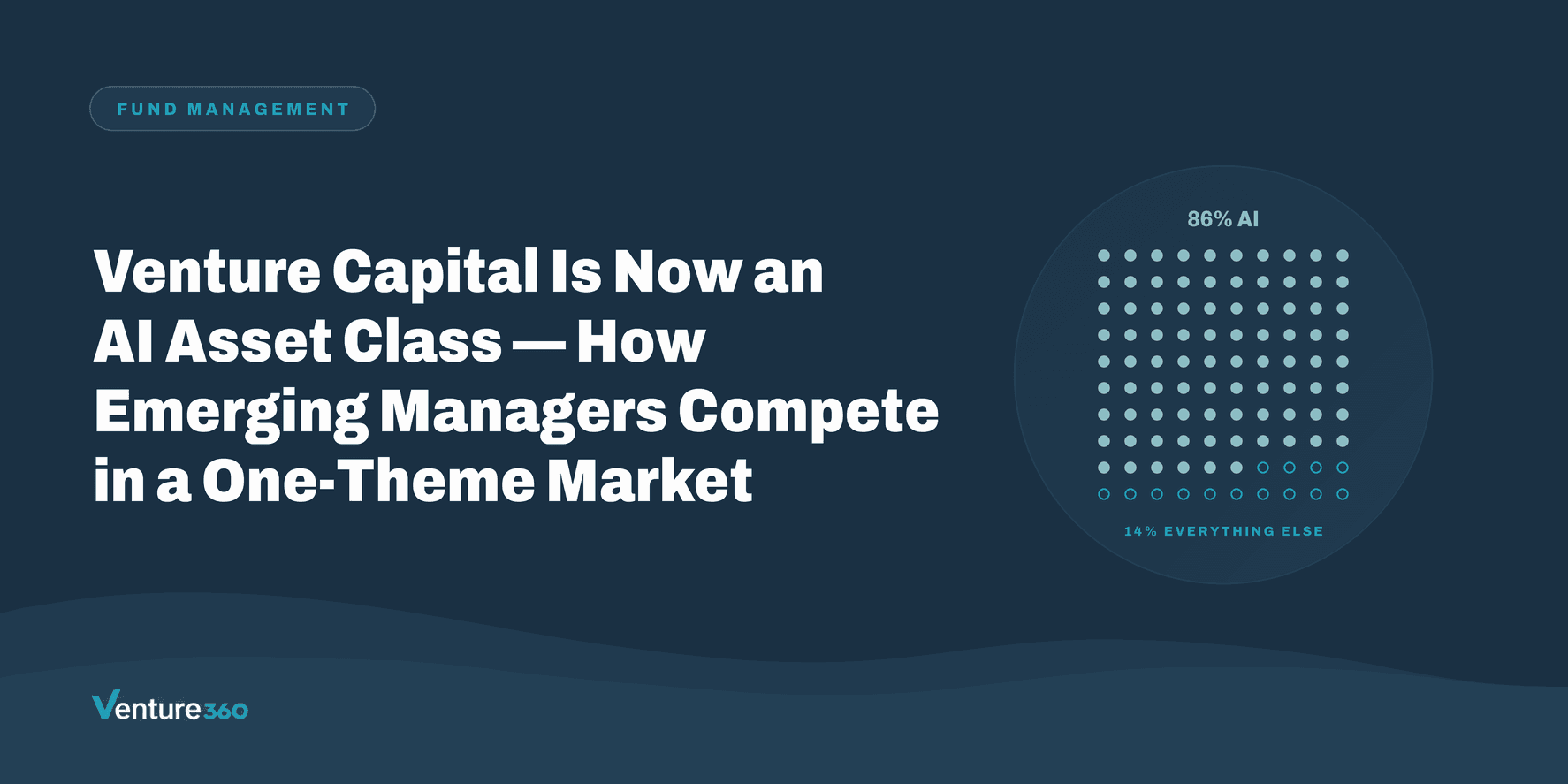
Strip the AI deals out of H1 2026 and the record venture market disappears. That's the honest read of the numbers: 86% of every venture dollar deployed in the first half went into AI-focused companies. Megadeals of $100M+ captured 87.5% of the $412.7 billion deployed. The $510 billion record half-year wasn't a broad recovery. It was an AI supercycle wearing one.
For fund managers, this raises an uncomfortable strategic question. When one theme absorbs almost all the capital, the attention, and the markups, what is everyone else supposed to do? The answer is not "become the 400th undifferentiated AI fund." But it's not "ignore AI" either.
What the 86% actually means
First, precision about what's being funded. The AI share is inflated by a small number of enormous foundation-model and infrastructure rounds, the megadeal layer where scale itself is the strategy. Below that layer, the market is more textured:
- Application-layer AI companies raising ordinary seed and A rounds
- Vertical software with AI-native cost structures
- Picks-and-shovels businesses around data, evaluation, security, and deployment
Second, precision about what's not being funded. The 14% left for everything else is spread across every other sector of the economy: healthcare services, fintech, climate, industrials, consumer. That scarcity cuts both ways. Portfolio companies outside AI face a harder fundraising path, but investors in those sectors face dramatically less competition and better prices than at any point in years.
Third, the exit market is validating the cycle rather than cooling it. H1 2026 exit activity soared, headlined by SpaceX's IPO (which generated more exit value in a single quarter than the prior decade combined) and strong AI-driven M&A. Liquidity flowing back to LPs from tech winners tends to get recycled into the same theme. The concentration is self-reinforcing, at least for now.
The historical rhyme managers should keep in mind
Every supercycle in venture history (PCs, internet, mobile, cloud) followed the same arc:
- Infrastructure gets overfunded first
- The durable returns migrate to the application layer
- A large share of the capital deployed at peak concentration is eventually written off
The internet was real and 1999 vintages were terrible. Both things were true. AI is almost certainly real, and 2026's most crowded rounds will almost certainly include some historic capital destruction.
Emerging managers can't time that turn. But they can position for it: the best-performing funds of the post-bubble internet era were the small, disciplined vehicles deployed after the correction into the application layer. The playbook is old; only the technology is new.
What emerging managers can do to be competitive
Pick a real position on AI. Don't drift into one. LPs will ask, and "we look at AI opportunistically" is not an answer. Defensible positions include: an application-layer thesis in a vertical where you have operator depth; an infrastructure-adjacent thesis (data, security, evaluation, deployment) that wins regardless of which model providers survive; or a deliberately contrarian non-AI thesis with the discipline to explain why scarcity of capital in your sector is your edge. Any of these can raise. Drift can't.
Underwrite AI-native economics in every deal, including the non-AI ones. The question that matters at seed in 2026 isn't "is this an AI company?" It's "does this company's cost structure and roadmap survive a world where software is built by teams a third the size, and where incumbents ship AI features every quarter?" Apply it to everything you fund. This is the new version of "does this survive mobile?" from 2010, and the funds that asked it early won that decade.
Avoid the megadeal shadow. The worst place for a small fund in this market is writing small checks into hot, oversubscribed AI rounds at prices set by billion-dollar funds. You get the entry price of the bubble with none of the ownership that makes it worth the risk. If you can't get meaningful ownership, the deal isn't differentiated exposure; it's expensive beta. Let it go.
Build the boring moat: evidence. In a market this narrative-driven, the emerging managers who stand out with LPs are the ones who bring receipts: clean portfolio data, honest markups, transparent capital accounts, and reporting that shows exactly how the thesis is playing out deal by deal. When every pitch deck says "AI," verifiable execution is the differentiator. This is where Venture360 earns its keep for emerging managers, with real-time portfolio tracking, fund and SPV reporting, and LP dashboards that make a first-time fund look and operate like an institution.
Use SPVs to prove the thesis before the fund. With blind-pool capital scarce, deal-by-deal SPVs are the emerging manager's proof-of-work. They demonstrate access, judgment, and execution to LPs who won't yet commit to a fund. A track record of well-run SPVs in your thesis area, with clean reporting and happy investors, is the strongest fund-one pitch available in 2026.
A one-theme market feels claustrophobic from the inside. But the 86% number is better read as a map of where the crowd is, and venture returns have never come from standing in the middle of the crowd. They come from the edges, priced sanely, entered early, and managed well.
How Venture360 helps emerging managers compete
In a narrative-driven market, the differentiator is evidence, and evidence requires infrastructure. Venture360 is that infrastructure for emerging managers:
- SPV management built for the proof-of-work strategy: spin up, administer, and report on deal-by-deal vehicles with the same rigor as a fund, so every SPV strengthens your fund-one track record
- Portfolio tracking that shows the thesis working, deal by deal: initial vs. current value, round-by-round history, and performance metrics LPs can verify rather than take on faith
- Investor-grade reporting on autopilot, so your quarterly updates carry clean data and honest markups instead of adjectives
- A consolidated view across funds, SPVs, and entities, which becomes the single source of truth when LPs diligence your next vehicle
When every deck says "AI," the manager with verifiable execution wins the meeting. Venture360 is how small funds bring receipts.
Talk to us
Ready to transform your investment operations?
Join the leading fund managers and syndicates already leveraging Venture360 to accelerate deals, streamline back office, and unlock real investor liquidity.
Sources: PitchBook-NVCA Venture Monitor, Q2 2026; Crunchbase News, "Global Startup Investment Hit Record $510B In H1 2026 As AI Boom Accelerates Funding And Exits."