
Raising a Seed Round Is Harder Than Ever — Here's Why, and What It Means for Emerging Managers
Global venture capital just posted its biggest half-year in history. $510 billion flowed into startups in H1 2026, blowing past all of 2025's total in six months. So why does every seed founder, and every seed-stage fund manager, feel like the market is tighter than it's been in a decade?
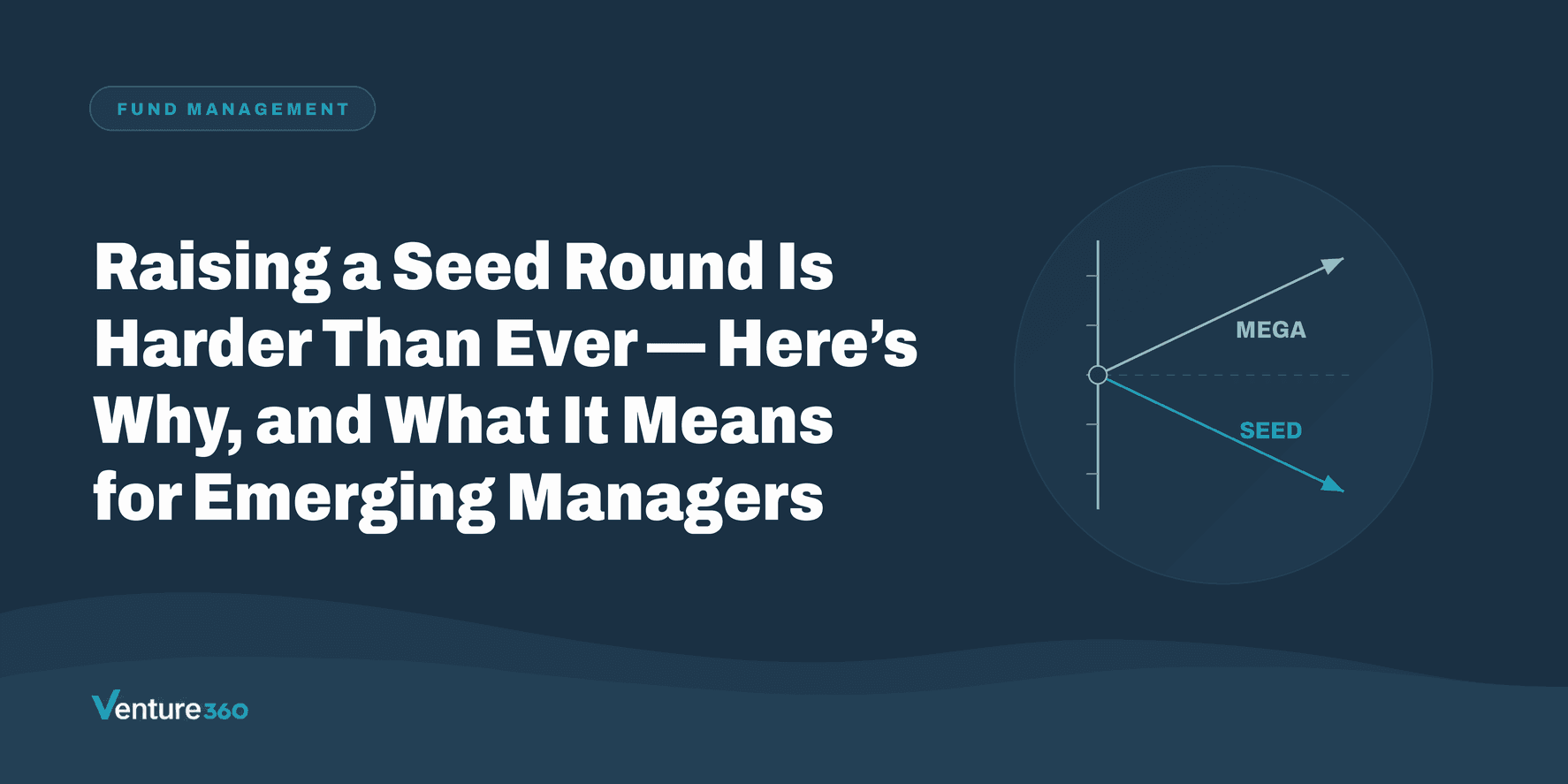
Because for the seed stage, it is. Seed funding fell 27% year over year in the same period the overall market set records. This isn't a contradiction; it's the defining feature of today's market. Analysts have started calling it the K-shaped market: mega-rounds soaring up one arm while the seed floor slides down the other. Understanding why this is happening, and where it creates openings, is the most important strategic exercise an emerging manager can do right now.
The numbers behind the squeeze
The headline stat is the funding decline, but the more consequential number is the graduation rate. Companies that raise seed rounds today reach Series A at roughly 9%, down from a historical norm of 15-20%. The cohort data makes the trend even starker:
- Startups that raised $1M+ seed rounds through 2020 graduated to Series A at rates above 55%
- The 2023 cohort managed just 24%
- The 2024 cohort is tracking at only 16%
Three mechanical forces are driving this.
The Series A bar has roughly tripled. The old benchmark of ~$1M ARR to raise an A is gone. As seed investor Andy McLoughlin put it, Series A investors now expect $2-3 million, even $4 million, in annual recurring revenue. Every seed company is being benchmarked against AI companies posting historically fast revenue ramps, and that recalibrated what "fundable traction" means for everyone, AI or not.
Seed rounds got bigger, so there are fewer of them. The median US seed round has tripled since 2018 to roughly $3 million, with upper-quartile rounds at $5.6 million and hot AI seeds commanding $8-10 million. Larger checks mean deeper diligence, more concentration, and fewer companies funded. Total seed dollars fell 27%; the deal count fell harder.
The wait between rounds stretched past two years. Companies now take more than 24 months to get from a $1M+ seed to a Series A. That means every seed dollar has to last longer, which raises the effective bar again. It also means seed funds wait longer to show markups to their own LPs.
Why this is happening now
The money didn't leave venture; it moved upstream. Megadeals of $100M+ captured 87.5% of the $412.7 billion deployed in H1 2026. The large multi-stage platforms that used to write seed checks as options on future rounds have redirected their attention to late-stage AI, where they can deploy hundreds of millions at once. A $3M seed check doesn't move the needle for a $20B fund.
That leaves seed to dedicated seed funds, at exactly the moment those funds are having their own fundraising crisis. Emerging-manager fundraising is down roughly 35% year over year, and first-time fund formation is on pace for its lowest year since 2016. Fewer active seed funds means fewer checks, slower rounds, and more leverage for the investors who remain.
In short:
- Record capital overall, but 87.5% of it captured by $100M+ megadeals
- Multi-stage platforms have pulled upstream and out of seed
- Emerging-manager fundraising is down ~35%, shrinking the pool of active seed investors
- The result: fewer, larger, slower seed rounds and a much harder path to Series A
What emerging managers can do to be competitive
The paradox of this market is that the squeeze is a supply-side problem, not a quality problem. Founder quality is arguably the best it has ever been, AI has collapsed the cost of building, and there are fewer funded competitors per deal than at any point since 2016. For managers who can actually close a fund, entry prices and selection at seed are the most attractive they've been in years. Here's how to compete:
Underwrite to the new bar, not the old one. If Series A requires $2-4M ARR, your seed underwriting has to model a credible path to that number on a single round plus reserves. Deals that needed the old $1M-ARR bar to work are structurally broken. Build portfolio construction around 24-30 months of runway per company, not 18.
Make the seed-to-A bridge your product. The single biggest failure point in your portfolio's journey is now the A. Managers who bring real graduation infrastructure win: revenue-focused operating support, warm Series A relationships cultivated before the raise, and disciplined milestone planning at investment. That is something founders desperately need and most seed funds don't deliver.
Lean into the vacuum the platforms left. Multi-stage firms pulling upstream means less competition for well-priced seed rounds outside the hottest AI deals. Contrarian sector focus, geographic focus, or genuinely differentiated sourcing matters more when the tourists have gone home.
Treat LP reporting as a competitive weapon. In a market where LPs are anxious and markups are slow, the managers who win re-ups are the ones whose LPs always know exactly what they own, what it's worth, and what happened this quarter. Institutional-grade transparency from fund one is now table stakes for raising fund two, and it's one of the few competitive levers entirely within your control. This is precisely the problem Venture360 was built to solve: real-time capital accounts, portfolio reporting, and LP dashboards without a back-office team.
The K-shaped market is brutal for undifferentiated capital. But seed investing has always generated its best vintages in the years when capital was scarce and conviction was expensive. This is one of those years.
How Venture360 helps seed managers compete
The seed squeeze rewards managers who can prove discipline: to founders deciding whose money to take, to Series A investors diligencing your portfolio, and to LPs deciding whether fund two gets funded. Venture360 gives emerging managers that proof layer:
- Real-time portfolio tracking across every fund and SPV, so you always know which companies are on pace for the new Series A bar and which need attention
- Capital accounts mapped to every LP, with each dollar committed, called, and distributed broken out line by line, so slow-markup periods don't become trust problems
- Performance reporting built in (ROI, MOIC, distributions, value change over time) that turns quarterly updates from a spreadsheet scramble into a five-minute export
- Clean, exportable holdings data you can hand a Series A investor diligencing one of your companies, which makes your fund a better co-investor to have on the cap table
In a market where the seed-to-A bridge is the product, operational clarity is part of how you build it.
Talk to us
Ready to transform your investment operations?
Join the leading fund managers and syndicates already leveraging Venture360 to accelerate deals, streamline back office, and unlock real investor liquidity.
Sources: PitchBook-NVCA Venture Monitor, Q2 2026; Crunchbase News, "Seed Deals Keep Getting Bigger As Odds Of Reaching Series A Fall Dramatically" (2026); Tech Times, "VC Hit $392B: Seed Funding's 27% Drop Signals a K-Shaped Startup Market" (July 2026).